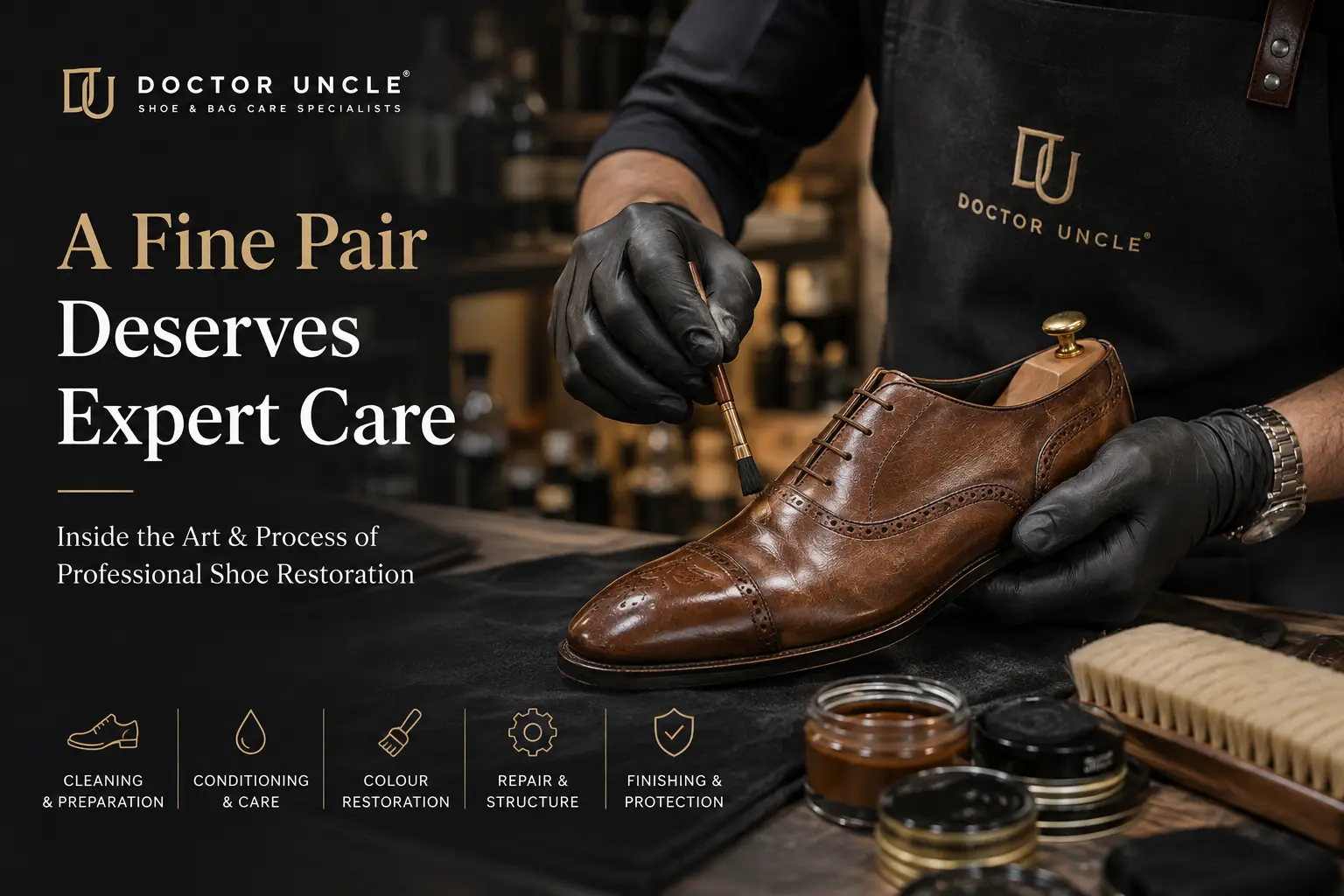
A fine pair of leather shoes can carry years of memories, craftsmanship, and personal style. Yet even the best footwear eventually shows its age: the leather loses its depth, the colour fades at the toe, creases become pronounced, and heels or soles begin to wear unevenly. The difficult question is often not whether the shoes look tired, but whether they can be restored without compromising their character.
In many cases, the answer is yes—but fine footwear requires more than a quick polish. Leather shoe restoration is a considered process involving material identification, controlled cleaning, conditioning, colour correction, structural repair, and careful finishing. The objective is not to make every pair look artificially new. It is to return the shoes to a well-maintained, wearable condition while preserving the qualities that made them valuable in the first place.

Table of Contents

What Is Leather Shoe Restoration?

Leather shoe restoration is the professional care and repair of footwear that has suffered from dirt, dryness, scuffing, fading, stains, colour transfer, creasing, or construction-related wear. It may be as focused as restoring colour to a worn toe or as comprehensive as combining leather cleaning, recolouring, sole repair, heel work, and refinishing.
Restoration begins with assessment. A specialist examines the leather, finish, stitching, lining, sole, welt, heel, hardware, and any brand-specific details. This matters because the same treatment cannot be used safely on full-grain leather, delicate calfskin, suede, patent leather, and synthetic materials.
The final result also depends on the condition of the shoe. Surface dirt and mild fading may respond well to professional care, while deep cracking, severe staining, damaged structural components, or previous amateur treatments may limit what can be achieved. An honest assessment is part of responsible restoration.

Why Fine Leather Footwear Needs Specialised Care

Luxury and designer shoes from houses such as Gucci, Louis Vuitton, Dior, Chanel, Ferragamo, Valentino, Tod’s, Christian Louboutin, and Prada often combine distinctive finishes with carefully selected materials and detailed construction. Their appearance may depend on subtle variations in grain, sheen, colour, edge paint, stitching, or decorative elements.
A strong cleaner, unsuitable conditioner, or aggressive brushing technique can alter that appearance permanently. Excess moisture may affect shape or finish. Excessive heat can dry or distort leather. An incorrect pigment can cover the original tone rather than recreate it. On a pair with a special finish or contrasting trim, a treatment that seems harmless on one panel may create an obvious mismatch on another.
Professional restoration therefore requires restraint. Good work is measured not only by what is added, but also by what is protected.
 

The Main Stages of Professional Leather Footwear Restoration

1. Inspection and material identification

The first stage is a detailed visual inspection. The condition of the upper, toe box, vamp, quarters, tongue, lining, sole, heel, and edges is recorded. The restorer looks for dryness, abrasions, loose stitching, cracking, staining, colour loss, peeling finish, and signs of earlier repairs.
Material identification is equally important. Full-grain leather, corrected-grain leather, calfskin, suede, nubuck, patent leather, exotic leather, and synthetic materials can react very differently to cleaning products and dyes. If the material or finish is uncertain, testing should be carried out discreetly before any broad treatment begins.

2. Controlled cleaning

Leather shoe cleaning is not simply a matter of removing visible dirt. The process must lift soil without stripping away the finish, natural oils, or colour. A professional may use different methods for the upper, welt, sole edge, lining, and decorative components.
Suede and nubuck demand particular care because their textured surfaces can be flattened or marked by excess liquid. Patent leather has a glossy surface that may become cloudy or scratched with an unsuitable product. Exotic leather may have a scale pattern or finish that requires a separate treatment approach.
Cleaning should also be proportionate. Over-cleaning can be as damaging as neglect, especially when the original finish is already fragile.

3. Conditioning and moisture balance

After cleaning, appropriate leather conditioning can help improve suppleness and the visual depth of the material. The correct product and quantity depend on the leather, its finish, its age, and the intended final appearance.
Conditioning is not a cure for every problem. It cannot reliably reverse deep structural cracking, replace missing finish, or repair torn leather. Applying too much product may darken the surface, leave residue, or affect adhesion during later recolouring. For that reason, conditioning is best treated as one step within a wider restoration plan rather than a universal solution.

4. Colour correction and recolouring

Leather recolouring is one of the most technically demanding parts of restoration. A restorer must consider the existing colour, undertone, level of fading, finish, and the way light reflects from the surface. The aim is usually to create a balanced match across the pair, not merely to cover the most visible scuff.
Small abrasions may require local colour correction. More extensive fading can call for broader refinishing. Special care is needed around contrast stitching, logos, piping, perforations, and panels made from different materials. A successful result should look natural at normal viewing distance and remain consistent across the shoe.
Colour restoration also has limits. If the leather is severely cracked, delaminated, chemically damaged, or missing substantial material, recolouring alone may not restore its original appearance. A professional assessment helps set realistic expectations before work begins.

5. Sole, heel, and structural repair

The upper is only part of a fine shoe. Worn heel tips, damaged sole edges, loose components, and compromised stitching can affect comfort, balance, and future wear. Depending on the construction, a pair may benefit from heel repair, sole repair, edge refinishing, or resoling.
These repairs must respect the shoe’s original proportions and construction. A visually attractive upper cannot compensate for a poorly aligned heel or an unstable sole. Restoration is most successful when cosmetic and structural work are considered together.

6. Finishing and final inspection

The final stage may include polishing, edge treatment, protective finishing, brushing, and shape correction. The shoes are then inspected for colour consistency, residue, loose threads, uneven sheen, and functional issues.
A careful restorer also checks whether the finished pair still reflects the character of the original design. The goal is refined preservation—not an overworked surface that hides the leather’s natural appearance.

How Different Materials Should Be Treated

Material

Key characteristics

Restoration considerations

Full-grain leather

Calfskin

Suede
 
 
Nubuck
 
Patent leather
 
Exotic leather
 
Synthetic materials

Naturally expressive surface with visible grain and patina

Fine, smooth, and often more delicate in appearance

Soft, napped surface that creates its characteristic texture

Fine sanded surface with a short nap

High-gloss coated finish
 
Distinctive texture, scale, or grain pattern
 
Manufactured surface with varied coatings and finishes

Use controlled cleaning and conditioning; preserve the original grain and finish rather than applying heavy coverage.

Avoid aggressive abrasion and excessive moisture; colour correction should be subtle and even.

Use material-specific brushing and cleaning; do not treat it like smooth leather.

Requires careful stain and nap management; harsh products can create permanent dark patches.

Protect the surface from scratching, clouding, and incompatible solvents.

Treatment should account for the pattern, finish, and sensitivity of the specific leather.

Test first; leather products may not behave predictably on synthetic uppers.

Professional Restoration vs DIY Care

Routine maintenance can be handled at home when the task is simple and the material is clearly understood. Brushing away dry dust, using suitable shoe trees, storing footwear in a cool dry place, and applying a product designed for the specific material are sensible habits.
DIY treatment becomes risky when the shoes are expensive, unusually coloured, heavily stained, structurally damaged, or made from delicate or unfamiliar materials. Common mistakes include using household detergents, applying shoe polish to suede, saturating leather with water, drying shoes near a heater, using a permanent marker on scuffs, and layering products without checking compatibility.
Professional leather restoration is recommended when the damage affects more than the surface, when colour needs to be matched, when the finish is delicate, or when the consequences of an incorrect treatment would be costly. A specialist can also distinguish between a problem that needs cleaning, one that needs recolouring, and one that requires repair or replacement of a component.

Common Leather Shoe Restoration Mistakes

The most frequent mistake is treating all footwear as if it were the same. A smooth black leather shoe, a pale calfskin loafer, a suede boot, and a patent leather pump need different care decisions.
Another mistake is trying to conceal damage too quickly. Heavy polish can temporarily darken a scuff but may leave an uneven surface or make later restoration more difficult. Similarly, forcing a shoe to look “brand new” can remove the patina and visual character that owners value.
Finally, delaying assessment can allow a manageable issue to become a structural one. Persistent dampness, deep cracking, loose soles, and worn heels deserve attention before the next season of regular wear.

How to Care for Restored Leather Shoes

Restoration is an investment in continued use, so aftercare matters. Allow shoes to air naturally after wear and avoid storing them while damp. Use shoe trees where appropriate to support shape and reduce excessive creasing. Rotate frequently worn pairs rather than wearing the same shoes every day.
Remove surface dust with a soft, material-appropriate brush. Apply conditioner or polish sparingly and only when it is suitable for the leather and finish. Keep light-coloured footwear away from dark garments or surfaces that may transfer colour, and store luxury shoes in a clean, breathable environment away from direct sunlight and extreme heat.
If a stain, crack, or finish change appears, stop experimenting with products and seek an assessment. Early intervention generally gives a restorer more options than a heavily layered or chemically altered surface.

Choosing a Leather Restoration Service

A reliable restoration provider should explain the proposed treatment before work begins. Look for a clear assessment, realistic expectations, attention to material differences, and an understanding of both cosmetic and structural footwear repair. The provider should be willing to discuss what may improve, what may remain visible, and whether restoration is appropriate for the item.
For owners in Delhi, Gurgaon, Noida, and across NCR, Doctor Uncle offers professional footwear cleaning, repair, restoration, colour restoration, and related luxury accessory care. The service also supports customers across India through pickup and delivery. Its broader offering includes sneaker cleaning, handbag cleaning and restoration, leather care, sole and heel repair, and luxury luggage repair. See the for the available categories.
 

Frequently Asked Questions

No. The outcome depends on the type and depth of damage, the condition of the leather, the original finish, and any previous treatments. Surface dirt, mild fading, and limited scuffing may respond well, while severe cracking, tears, chemical damage, or missing material may remain partly visible. A professional assessment is the best way to understand the likely result.

When the construction and upper remain sound, restoration can extend a shoe’s useful life and preserve its original design. It may also be preferable for discontinued, sentimental, designer, or well-made footwear. Replacement may be more sensible when the structure is extensively compromised or repair would not be proportionate to the shoe’s value.

No. Suede has a napped surface and should not generally be treated like smooth leather. Regular polish can flatten the nap, create uneven darkening, or leave a difficult-to-remove coating. Use products and techniques intended specifically for suede, and consult a specialist for significant stains or water marks.

Polishing primarily enhances shine, tone, and surface appearance. Recolouring addresses more substantial fading, abrasions, or loss of pigment and requires controlled colour matching and application. Recolouring is a restoration process, not simply a heavier version of polishing, and it should account for the shoe’s finish and construction.

Some stains can be reduced or removed, but no responsible restorer should promise a perfect result before inspecting the footwear. The stain’s composition, age, depth, material, and any previous cleaning attempts all matter. Aggressive home treatment can make the mark more permanent, so heavily stained luxury footwear should be assessed before further products are applied.

There is no universal schedule. Frequency depends on how often the shoes are worn, the climate, storage conditions, material, and the type of use. Regular at-home maintenance and prompt attention to early wear can reduce the need for major restoration. A professional visit is appropriate when cleaning no longer improves the appearance or when structural wear becomes noticeable.

Doctor Uncle serves customers in Delhi, Gurgaon, Noida, and the wider NCR region, with Pan India pickup and delivery available for relevant services. Customers can contact the team for an assessment of leather footwear, sneakers, handbags, and other luxury accessories.